Small Qwen2.5-Coder models (0.5B–7B) are trained with Group Relative Policy Optimization to solve GSM8K problems by reasoning and then writing Prolog. Each answer is executed by a live SWI-Prolog interpreter inside the RL loop, and a composite reward scores both logical correctness and output structure, improving reasoning quality and code accuracy on underrepresented languages.
A Blender add-on that turns a natural-language description into an executable Blender Python script. Retrieval over a curated dataset of 500 expert-validated (text, code, image) examples across 50 object categories raises the compilation success rate from 40.8% to 70.0% and CLIP alignment from 0.41 to 0.77 across four LLMs, with no fine-tuning.
Recurrent and feed-forward networks trained on FastF1 telemetry to predict the best tyre compound for each lap of a Formula 1 race. The GRU reached 51.4% accuracy, against 28.1% for the LSTM, 27.1% for the MLP and 24.5% for a blind classifier.
A fork of the official HRNet implementation with the instructions and code changes needed to train it on your own keypoint dataset (COCO format, 12 keypoints instead of 17), plus inference on images and videos. On a 374-image custom dataset, HRNet-W48 (384×288, pretrained) reached 0.568 AP and 0.950 AP50.
An LSTM trained on the UCI Human Activity Recognition dataset to classify six activities (walking, walking upstairs, walking downstairs, sitting, standing, laying). The PyTorch model is converted to TensorFlow Lite and then to a C header, and runs in real time on an M5Stack Gray using its built-in IMU. Test accuracy settles at about 92%.


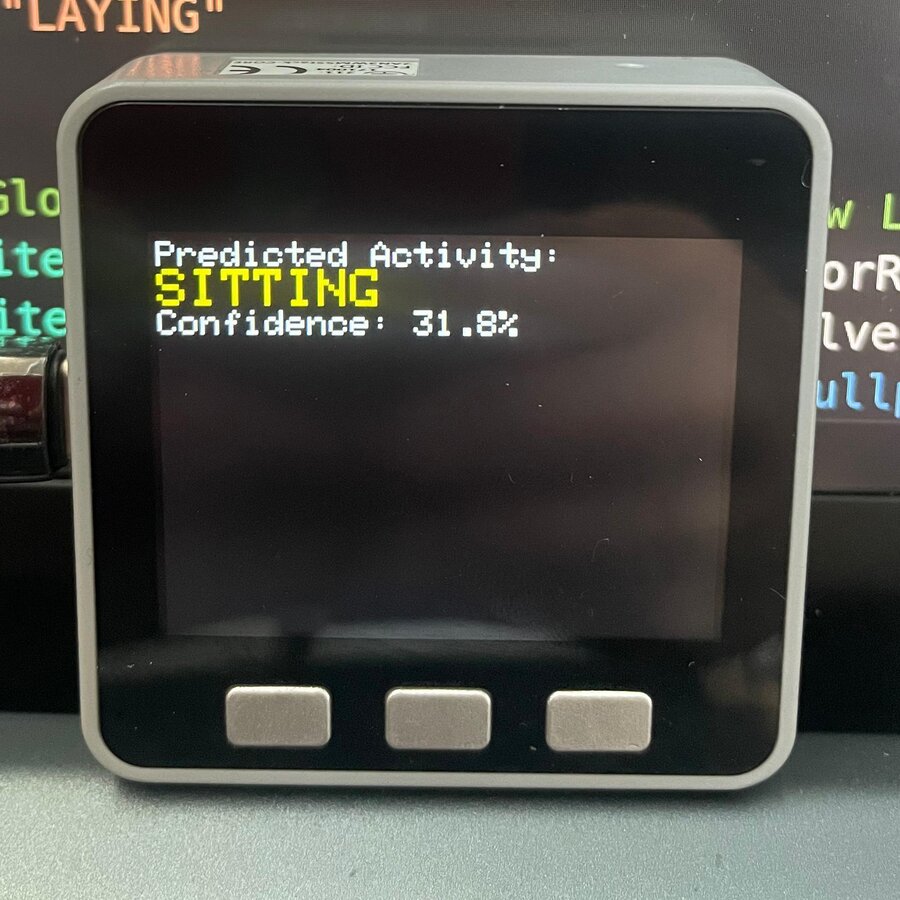 2024 · Python, PyTorch, TensorFlow Lite, ESP32 / M5Stack